


After 2 years of complete AI slop chaos and Google rewarding junk content left and right, we are at a crossroads: multiple SPAM updates, targeting bulk AI-generated content, low-value programmatic SEO, and unoriginal scaled articles.
The aftermath is brutal for many websites.
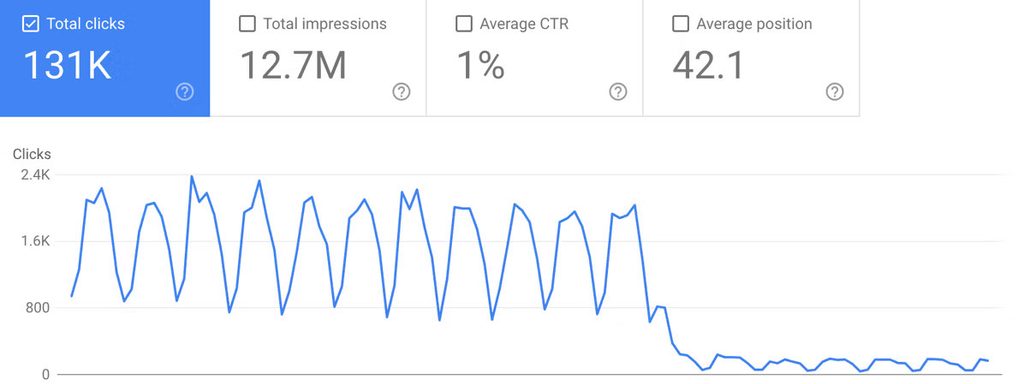
While millions of webmasters have reported a slight decline in search traffic, due to increased AI use, this type of drop is clearly unnatural and it happens because Google are deindexing pages left and right, while also handing in manual penalties like it’s Halloween.
The reason?
Scaled content, useless AI drivel, articles nobody wants to read, with no personality or demonstrated expertise. In short: junk.
In the past 12 months, 90% of the medical SEO audits I’ve done uncovered thin AI generated content. People are discovering how easy it is to tell ChatGPT “write an article on Neuroblastoma” and then just copy-paste on their website.
Even worse, some are asking for topical maps and content briefs, forgetting that AI doesn’t reason; it’s a language model (which means it puts words together in a certain order). Can it be used sparingly? Yes. Should you do all your work with AI? No, unless you’d like to have a traffic chart like the one above.
Based on all my recent audit work and our experience in keeping rankings for our clients or helping others recover, here are some best practices and tips for medical copywriting.
Table of Contents
Understand what Cost of Retrieval (CoR) is and how it works in SEO
As a crime movie buff, when I try to find out “who did it“, I know to always follow the money. It’s the same principle we apply in our small business coaching and everyday life. And, you guessed it, money matters in SEO quite a bit.
The cost of retrieval (CoR) is the total computer power, time, and bandwidth a search engine uses to crawl, render, and understand a webpage.
So, the fact Google was bombarded with billions of junk pages, all which needed to be crawled and ranked, started to cost them too much. Just like your phone, for instance, when it’s filled with useless apps and silly videos. You either upgrade or clear up your digital garbage.
At a huge scale, that’s exactly what Google is doing right now: clearing the mess and attempting to index only the content that has a reason to exist.
Quality content before everything else
99% of the website that were obliterated from the search had one issue: AI slop, thousands of location pages with zero value, lifeless articles created in bulk to have some “content”.
Before you blame the search engines, think “is my content really worth indexing or is it just taking up space?“.
When you post an article about the “benefits of Ozempic” for instance, you should aim to produce the BEST POSSIBLE PAGE in the world on your chosen topic. If you look at the top rankers (which you should when you create your content brief anyways) and then at what you produced, if yours is the most comprehensive and useful, chances are you’ll get decent rankings and, more importantly, patient bookings.
All things being equal, when a prospective patient looks at 2 websites, they’ll choose the one with more high-quality content than an empty one or showing junk articles. In medical copywriting, authority is easy to establish, if you invest effort in educational content.
Beware of AI watermarking
An AI watermark is an invisible, machine-readable signature embedded into text, images, audio, or video generated by artificial intelligence. For content, large language models (LLMs) subtly tilt the odds toward certain words. This creates an invisible statistical pattern across a block of text without changing its meaning. Invisible to you, as a human, visible to Google and AI models.
Is Google going to penalize websites using AI to write content?
Not yet, but it hasn’t penalized mass content generation or programatic SEO until recently. So tread carefully.
You can still use AI to help you with writing, but you should build chunks of content, ask questions and then filter the product through your own eyes and personality.
Do not generate the entire article with AI
Instead of generating a slop article on How long do anxiety attacks last?, create a proper content brief and then ask questions in AI chatbots. Take the answers one by one, EDIT with your OWN EXPERTISE, change wording to make it sound natural and build the article.
Create a comprehensive content brief
And please don’t ask ChatGPT to do it for you.
I have attached the heading structure used for the article in the above example. Notice:
- CLEAR heading hierarchy – just like a book, the article has 1 H1 heading (the title), then main topics and sub-topics.
- Active voice – no “doing”, “making” and useless words. What it is, how it works, what to do, why. AI generated articles are filled with fluff and gerunds, which is far from how WE speak on a daily basis.
- We always define what we write about, hence the first heading “what is an anxiety attack”.
H1: How long do anxiety attacks last? A guide to duration, symptoms, and recovery
– H2: What is an anxiety attack?
– H2: Anxiety attack vs. panic attack
– H2: How long does an anxiety attack last?
– – H3: Can an anxiety attack last days?
– – H3: Why does time feel distorted during an attack?
– H2: What factors influence how long an attack lasts?
– H2: What to do during an anxiety attack
– – H3: Deep diaphragmatic breathing
– – H3: The 5-4-3-2-1 grounding technique
– – H3: Find a quiet space
– – H3: Use a grounding object
– H2: Long-Term Strategies to Reduce Frequency and Duration
– – H3: Cognitive Behavioral Therapy (CBT)
– – H3: Mindfulness-based practices
– – H3: Regular exercise, sleep, and nutrition
– -H3: Limiting caffeine and alcohol
– H2: When to Seek Professional Help
– H2: Key Takeaways
Ain’t gonna take a minute, but you will create a high-quality resource your potential patients would want to read and Google would have no issues in indexing and ranking high.
Focus your article on one topic only
What ChatGPT loves to do, when prompted to give ideas, is to make a mish-mash of topics and titles. And then, you have it write the article that sounds OK, but has zero actual meaning.
Let me explain.
Title: Neurodivergence: How ADHD Impacts a Patient’s Life
Doesn’t sound bad, does it?
But, SEO-wise and from a logic standpoint it’s a disaster.
What do you write about? Neurodivergence? In that case, your title should be “Neurodivergence: What It Is, Symptoms & Types“. In this article you will mention ADHD, which is a TYPE (so a sub-topic), together with Autism Spectrum Disorder (ASD), Dyslexia, Dyscalculia and a few more.
See where I’m getting at?
You can ignore me and say “what does Ramona know about medical copywriting, I’ll do it how ChatGPT tells me to”. Fine by me, so we’ll have another article: “Neurodivergence: How Autism Spectrum Disorder (ASD) Works“.
Now you probably see the issue.
In SEO, we “frontload” the main keyword/entity or whatever you wish to call it. So both these articles, SEO-wise would want to rank for “Neurodivergence“, cause that’s what you mentioned first.
What next? If your articles won’t be nuked as AI slop, they’ll somehow rank all over the place. You’ll have cannibalization for the “Neurodivergence” keyword, because the search engines won’t understand which of these pages actually deal with it.
The right way to do it: pillar page on Neurodivergence. While it won’t outrank WebMD and Mayo Clinic, I’m a huge proponent of extensively written articles on the CONDITIONS you treat. Then, sub-pages on EACH TYPE.
Your topical authority map would look something like this:
- Conditions
- Conditions -> Neurodivergence
- Conditions -> Neurodivergence -> ADHD
- Conditions -> Neurodivergence -> ASD
- Conditions -> Neurodivergence -> Dyslexia
See how beautiful and logical this is?
Now, if I write a blog post on “ADH vs Autism” (believe me you’ll do it, it’s a HUGE keyword), after I defined each and explained, I can easily link towards the “Neurodivergence” page, than each separate sub-topic.
Even better, on the ADHD page for instance, if you use WordPress especially (other platforms allow it too), you can show ONLY the articles on ADHD. So, instead of the general “latest blog posts” list, you can query the exact sub-category.
Talk about topical relevance!
Add your own expertise
There’s a lot of taking on EEAT, so personal expertise matters more than ever.
If you are writing an article on “Mounjaro vs Ozempic” for instance, after you have created your custom content brief and used AI to speed up your writing, by asking specific questions, add your intel.
“In our practice, we have noticed that patients who used Mounjaro for their Type 2 Diabetes, improved their A1C by 10%, while patients on Ozempic did by only 2%”.
See how powerful this is?
Instead of that ChatGPT drivel “in the ever evolving landscape of Type 2 Diabetes treatment“, or just incorect/boring AI slop, you are now showcasing your expertise as a doctor who prescribes medication, keeps tabs on how their patients are doing and can offer impossible to duplicate expert data on the topic at hand.
Your medical content turned from “commodity”, which means even my dog can generate it with AI, to something that adds HUGE value to anyone who’s interested in these treatment options.
And now, think again: all things being equal, who do you think gets the patient?
You, with your excellent article, with personal expertise and real data or a “rank and rent” fake website with junk content? Or, even better (for you), a competitor who has “automated” their writing.
Lose the AI jargon and write like normal people
“Reshape”, “transform”, “navigate” etc.
What are you reshaping? Unless you’re a plastic surgeon, nothing here to reshape. Transform? Are we in the Harry Potter or Chronicles of Narnia books? Navigate? Unless you own a yacht and you’re doing that exactly, there’s no reason to use this type of wording.
What are your patients’ pains?
Some have Diabetes. Some have a broken arm. Others are either trying to conceive or have contractions. Chances are they won’t be interested in navigating anything, nor reshaping.
You can really help with a better approach:
“Go to the nearest emergency room immediately if you think you have a broken arm.” has more value than “in the ever evolving ..”.
For the love of God, stop leading with “it’s crucial”
Say you’re searching for “medical SEO audit“, right? And, when you open the page, the first thing you read is “for healthcare practices, a medical SEO audit is crucial …”.
Hellooooo, you searched for it. You arrived on the page. You know it’s crucial (hence you searching for the term, clicking on the blue link and reading my masterpiece).
It’s funny to me that, while the trend is for people to read less than before, everyone is happy to post long AI slop with paragraphs that sound OK, but are utterly useless.
Remember, your medical content needs to inform and help, not waste visitors’ time.
Be assertive in your writing
Don’t know, if you noticed, AI uses “may” and “can” a lot, so your AI writing has barely any power.
Imagine there’s a guy who likes you a lot and tells you “oh, tonight we may go to a concert or maybe we can see a movie. We can also walk in the park“.
Don’t know about you, but I’d send the guy packing immediately and ask him to come back after he grew a pair.
How would it sound better?
“I have 2 ticket concerts for tonight. If you don’t want to, I’ll give them to my friend and we can see a movie instead“.
It’s not even about him forcing me to do something, but it’s not a wishy-washy statement.
So, in your medical copywriting, steer away from sentences like “Ozempic may help lower your A1C” and go for a more assertive tone: “Ozempic (semaglutide) lowers A1C levels by an average of 1.4% to 1.6% in adults with type 2 diabetes“.
Now, out of the 2 sample sentences, which do you think shows authority and would get a better ranking?
Have a personality and show off your style
You’re all educated people: I assume you love a certain band (maybe Led Zeppelin, AC/DC, Reinaissance). You enjoyed reading Shakespeare (hey, no judging here) or are crazy about Ernest Hemingway.
What do all these preferences have in common?
You love a certain style. A personality.
And, if you ask me, besides slashing jobs left and right, AI has made us lose what makes us human: our personality.
When you read this article and are either offended (please don’t, not my intention) or amused, at least you feel “something”. You sense my style. I’m sarcastic, with enough expertise under my belt and a pretty original way to convey my teachings.
Instead of a dry SEO article on blah-blah … what was it all about .. ah, medical copywriting … you get an original tongue in cheek post that makes a lot of sense. I doubt our friend Google will deindex it as being AI slop, cause it ain’t.
Let your personality shine.
A medical article on “molar pregnancy” doesn’t have to be lifeless like an expose in a medical journal. Heck, it cannot be funny, since there’s nothing to laugh about. But it can be caring and kind, show passion for helping patients who face this ordeal.
It can present your OBGYN clinic in a positive way, showcasing your bedside manners, together with extensive information on what is happening to the patient and how you can help.
This type of extensive content, written with an expert voice, but still easy to understand has helped my OBGYN in Romania (before we immigrated) make a killing in Google Search from 2013 on.
And it makes sense: while competitors were barely putting together an “about us” page, she had hundreds of well-written articles on pregnancy (by week), gyno procedures, medication, treatments for various conditions, comparisons etc.
Faced with having to choose from an empty website and one with such a wealth of information, her patients were choosing to book from our website, not the competitors’.
I’ll add more data and insights, as I perform more audits and find issues that are worth sharing. If you’d like a “main takeaway”, provide high-quality in all your do on your website, too. Just like you are striving to be the best in your specialty, your website should show that.





[…] You can read my musings on this exact topic: Medical copywriting tips to survive Google algorithm updates. […]