

Your next patient is searching for you right now. The question is: will they find you or the practice down the street.
Google alone receives more than one billion health-related queries every day, covering everything from basic condition research to self-diagnosis and provider locations.
And around 79% of patients often or sometimes search online for doctors before making any contact. These are not abstract statistics. They represent appointment decisions being made in real time by people in your zip code and the practices that understand how medical SEO works are the ones capturing them.
This guide breaks down exactly how SEO works for medical practices: the components, the rules that make healthcare different from every other industry, and what it now means to rank in a world where patients are increasingly getting their answers from AI before they ever click a link.
Table of Contents
What Medical SEO actually is
SEO (search engine optimization) is the process of making your website more visible in organic search results. For medical practices, that means showing up when a patient in your area searches “dermatologist near me,” “best OB/GYN in [your city],” or “what are the symptoms of a herniated disc.”
SEO for medical practices consists of three major components:
- technical optimization, which addresses any site issues that may be preventing search engines from fully crawling its pages;
- on-page optimization, a collection of techniques that helps search engines better understand what the website is about;
- off-site signals, which build the authority and reputation of the practice across the web.
Unlike paid advertising, which stops delivering the moment your budget runs out, SEO builds a foundation that continues to drive traffic and attract more patients over time.
It is not a one-time project, it is an ongoing process. A medical website should constantly evolve as patient needs and behaviors change.
The practical result of a well-executed medical SEO strategy: a patient searches, your practice appears at the top of the results, they click through to a website that earns their trust, and they book an appointment.
Ka-ching!
Why Medical SEO is harder than SEO for other industries
A plumber and a cardiologist both want to rank on Google. The cardiologist faces a significantly higher bar.
Medical SEO is harder than SEO for other industries because Google holds medical websites to a higher standard known as YMYL — Your Money or Your Life. Because these sites impact health and well-being, your content must demonstrate specific qualities to rank.
Medical SEO requires compliance with healthcare regulations like HIPAA and must demonstrate E-E-A-T — Experience, Expertise, Authoritativeness, and Trustworthiness — since health content can influence major life decisions.
This means a generic web agency that builds sites for restaurants and law firms is not equipped to serve you well. They do not understand why a missing author bio on a blog post is an SEO problem, why your contact forms need to be HIPAA-safe, or why thin content on a treatment page is not just unhelpful, it actively damages your ability to rank.
The 5 pillars of Medical SEO
1. Technical SEO: the foundation you build on
You can have the best content on the internet and still rank nowhere if your website has technical problems that prevent Google from reading it properly.
Ramona’s 1st mantra in SEO: “if it ain’t indexed, it ain’t ranking”.
Why?
Think about Google (and other search engines) like a huge excel sheet (OK, global scale, but you get the idea). If your website is not listed there (successfully crawled and INDEXED), when people are searching for your practice or your medical services, you cannot show up in the search, because you are not in that humongous database.
And, guess what, AI is taking their results from the search engines (Google, Bing, Yahoo etc.) so you are clearly not going to be cited in LLMs in a million years.
This is why, during my medical SEO audits, indexation is one of the MAIN areas I look into. I had clients come to be, not knowing why they don’t appear in Google at all; why? because their non-SEO fancy web designer blocked the search engines in WordPress.
And the website was blocked for 3 years, until I came to do an audit and almost fell off my chair seeing such a sloppy work.
Site speed matters; Google recommends that sites load in under two seconds. Mobile-friendliness is non-negotiable, since more than 64% of web traffic now comes from mobile devices, and Google serves mobile-friendly sites first.
Getting in front of patients searching for a physical therapist or specialist in your area is imperative. A mobile-friendly, fast-loading site with a logical URL structure and clean internal link architecture is the foundation.
For medical practices specifically, technical SEO also includes HIPAA-compliant contact and appointment forms, HTTPS security across every page, and a crawlable site structure that lets Google index your service pages, provider profiles, and location pages without friction.
2. On-Page SEO: telling Google what you do and who you do it for
On-page SEO is how your website communicates its relevance to search engines. It covers your page titles, meta descriptions, heading structure, keyword placement, and the depth of content on each page.
Key areas to include keywords are page titles and meta descriptions — the first things users see in search results — as well as headers, which use keywords to structure content and signal relevance to search engines.
For medical practices, this means each service you offer should have its own dedicated page: not only a single “services” page that lists everything in bullet points, but individual pages for orthopedic surgery, sports medicine, joint replacement, and so on.
Each of these pages needs to answer the specific questions a patient is asking, demonstrate clinical depth, and be written or reviewed by a qualified professional.
3. Local SEO: getting found by patients near you
Most medical practices serve a defined geographic area. Local SEO is the discipline of making sure Google surfaces your practice for patients in that area.
Even in an AI-first world, 70% of patients still search for providers within 10 miles of home. Local SEO for medical practices remains one of the most critical strategies for attracting high-converting, location-based traffic.
The main focus of local SEO is your Google Business Profile.
Your GBP is one of the most powerful tools for local medical SEO. It appears when someone searches for your practice or related services on Google.
A fully optimized profile — with accurate name, address, and phone number; the right specialty categories; regularly updated photos; and a consistent stream of patient reviews — is often the difference between appearing in Google’s local “3-Pack” (the three practices shown prominently above organic results) and being invisible to patients in your area.
Beyond your Google Business Profile, local SEO involves building consistent citations across healthcare directories: Healthgrades, Zocdoc, Vitals, WebMD, and optimizing individual location pages if your practice has multiple offices.
Even for us, a small medical SEO company, local SEO has allowed the GBP to easily outrank huge competitors and gain clients. When competitors are investing millions every year in advertising, a small company like The Medically needs to leverage its proximity signals. So does your clinic.
4. Content strategy: earning authority by answering patient questions
Content is where medical SEO gets interesting and where most practices either build a meaningful competitive advantage or waste significant time and money.
According to Google, online search drives 3 times as many visitors to hospital websites compared to other sources.
One study found that 80% of US adults conducted a healthcare-related search in the last year. Those patients are looking for answers, and the practices that provide the best answers consistently accumulate traffic, trust, and appointments over time.
I remmeber in 2013, when I wasn’t even this deep in medical SEO, I met with my OBGYN and was blown away by how amazing she was. We decided to work together on her website and, without even knowing about content marketing, I proposed we should write about everything potential patients would be interested in: endometriosis, how an OBGYN consultation looks like, pregnancy (and its stages).
Back then in Romania, NOBODY was doing that, at least in our city.
As she took care of me, during my pregnancy, I was ferociously writing about all these topics myself, she’d approve the content and we’d post it.
The website went from nowhere (I built it myself from scratch) to dominating everything else in Timisoara (my hometown). The practice went from a small office in a pretty unappealing part of the city to the Victory Square (which is ground 0 in my city).
Thanks to her amazing medical skills and bedside manners, together with her husband (another great OBGYN) she scaled the business to a multi-million dollar company, which is huge, for such a small country.
Effective medical content strategy is built around topic clusters: a pillar page covering a broad subject (say, “hip replacement surgery”) surrounded by supporting content that covers every related question a patient might ask (recovery timelines, what to expect during the procedure, exercises to do before surgery, insurance coverage, risks).
This structure tells Google that your site has genuine authority over a topic, not just a single page that mentions it.
Refreshing content at least once a year is mandatory. Updating old content is a great way to boost medical SEO; going back to flesh out answers to patient questions, updating seasonal information, and adding new data and tips to older articles.
AIs also take into account this content freshness signal, they’ll always prefer to cite newer articles, even if some of the older ones could be better.
Every piece of content on a medical website should have a clearly identified author with verified clinical credentials, a last-reviewed date, and citations to peer-reviewed or authoritative sources. It is what Google’s Quality Raters look for when evaluating whether your content meets YMYL standards.
5. E-E-A-T signals: proving you are who you say you are
E-E-A-T (Experience, Expertise, Authoritativeness, and Trustworthiness) is Google’s framework for evaluating whether a medical website deserves to rank for health-related queries.
Keep the following in mind when working on your site’s E-E-A-T: create high-quality, informative About and Contact pages; include author information for all in-depth content with bios describing expertise and accreditation; make it easy for patients to contact your organization; include a privacy policy and terms and conditions; and add an easily identifiable address and phone number.
For a medical practice, E-E-A-T signals also include: provider profile pages with education, board certifications, and clinical focus areas; schema markup that identifies physicians, specialties, and the medical organization; backlinks from authoritative healthcare sources; and patient reviews that reflect the quality and trustworthiness of your care.
Structured Data: the signal layer most practices skip
Schema markup, also called structured data, is code added to your website that helps search engines understand the entities on each page: who the physician is, what specialty they practice, what conditions they treat, where the practice is located, and how to contact them.
Google’s AI Overviews and large language models rely heavily on structured, machine-readable markup.
A schema-rich medical website increases the chance of your practice being cited directly in AI-generated results. Using MedicalOrganization, Physician, and MedicalSpecialty schema on your website is now essential for AI visibility.
Practices that have properly implemented medical schema are not just better positioned in traditional search results. They are far more likely to be surfaced by AI systems when patients ask conversational health questions.
The LLM factor: why your SEO foundation now serves 2 masters
The search has changed in ways that would have been difficult to predict even 2 years ago. Patients are no longer only searching on Google. They are asking ChatGPT whether they need a specialist. They are querying Perplexity about post-surgical recovery. They are using Google’s AI Overviews and getting synthesized answers that may never require a click.
OpenAI reported in January 2026 that more than 40 million people ask ChatGPT healthcare questions every single day, and over 230 million people globally submit health and wellness queries to the platform every week.
3 in 5 US adults confirm they have used AI tools for health or healthcare in the past three months, with 55% using AI to check symptoms and 44% using it to evaluate treatment options.
AI Overviews currently appear for approximately 30 to 47% of US search queries, and healthcare and medical queries show higher AI Overview trigger rates due to their informational nature.
This is a HUGE shift in patient behavior. The question for medical practices is: what does it mean for your SEO strategy?
The practical effect is not that Google “doesn’t matter.” Because, if you fail in Google, you will fail in LLMs too.
It’s that the ecosystem around Google is expanding, and many Google searches are being answered by Google’s own AI layer anyway. A practice with a strong traditional SEO foundation (credible content, verified authorship, schema markup, topical authority, and solid E-E-A-T signals) is precisely the kind of practice that AI systems are built to surface.
The same qualities that earn you a top Google ranking are the qualities that make you a credible citation source for an LLM.
In our medical SEO work, based on our clients’ rankings and traffic, the websites that do well in Google, are getting picked up by AI. The ones that are still struggling, never get cited.
SEO and GEO (Generative Engine Optimization) work best together. Clinics must audit and adapt every touchpoint from core service pages to educational blog posts to be relevant for both Google algorithms and AI answer engines.
There are specific technical steps that improve your visibility in AI-generated answers:
- Structured data is the most direct signal you can send to an LLM. As noted above, properly implemented medical schema makes your content machine-readable in the way these systems require.
- Answer-first content structure. AI prefers content it can extract as a standalone passage — such as a clear summary at the top of a procedure page that answers the core question in plain language. Organizing pages so that the most important information appears first, written in direct language, dramatically increases your inclusion probability in AI-generated responses.
- LLMS.txt. This recently emerging convention gives AI crawlers explicit guidance on which pages should be used as citation sources. It is the AI-era equivalent of robots.txt and should now be part of your standard site configuration.
- Review strategy as a discoverability signal. When AI tools recommend local options, they don’t just look at your website copy. They sometimes lead with ratings and reputation signals, then cross-check whether the practice appears to offer the relevant treatment or service. Patient reviews that specifically mention treatment names, specialties, and conditions, not just generic praise, are increasingly valuable for AI discoverability.
- Video with transcripts. Having video on your site now plays a direct role in how AI engines surface content. Google AI often embeds YouTube videos directly into AI Overviews, and assistants like ChatGPT and Perplexity prefer citing content that exists in multiple formats.
How long does Medical SEO take to work?
This is the question every practice asks, and the honest answer is: it depends, but it is worth the wait.
According to First Page Sage’s 2025 click-through rate report, the top three organic results on Google capture 68.7% of all clicks. The number-one result alone receives 19 times more clicks than the top paid ad.
And a Backlinko analysis of four million search results confirms that only 0.4% of users ever navigate to the second page.
The investment in reaching those positions pays compounding returns. A practice that ranks in the top three for “cardiologist in [city]” continues to receive that traffic month after month, without paying per click.
Paid advertising stops working the moment the budget is turned off. SEO does not.
In competitive markets, meaningful movement in rankings typically takes 3 to 6 months for technical and on-page work, and 6 to 12 months for content and authority building to produce measurable results.
Practices in less competitive markets or underserved specialties often see movement faster. The variables are the competitiveness of the local market, how established competing sites are, and how consistently the strategy is executed.
What a strong Medical SEO strategy looks like in practice
Tying everything together, here is what a well-executed medical SEO program actually includes:
- A technically sound WordPress website: fast, mobile-optimized, HTTPS-secured, with a clean URL structure and HIPAA-safe forms. This is why we created our managed medical websites, so that all our clients use the same successful framework I used in decades to rank clients.
- Individual service pages for each specialty or treatment offered, written to clinical depth with verified authorship.
- A fully built-out and actively managed Google Business Profile.
- Consistent citations across healthcare directories.
- A content strategy built around topic clusters that establish genuine topical authority in your specialty area.
- Provider profile pages with credentials, board certifications, and clinical focus areas.
- Medical schema markup across all key pages.
- A patient review strategy that encourages specific, treatment-relevant feedback.
- An LLM-readiness layer (structured content, LLMS.txt configuration, and video) that positions the practice for visibility in AI-generated answers.
This is not a template that gets applied once. It is an active, evolving program that responds to algorithm changes, new patient behaviors, and competitive shifts in your local market.
The Medically was built for exactly this
Most web agencies treat medical practices the same way they treat any other client.
They build a website, shove some keywords, claim a Google Business Profile, and call it done.
They do not understand YMYL. They do not understand why your patient contact forms need to be HIPAA-compliant. They do not understand what it means to build topical authority in a specialty medical context, or how to structure content so that an LLM will cite your practice as a trusted source.
We do, because we have spent more than two decades building websites and executing SEO strategies exclusively for doctors, specialists, and medical practices.
Our clients include fertility clinics, surgical device companies, respiratory health providers, OB/GYN practices, dental groups, and multi-specialty practices across the US and internationally.
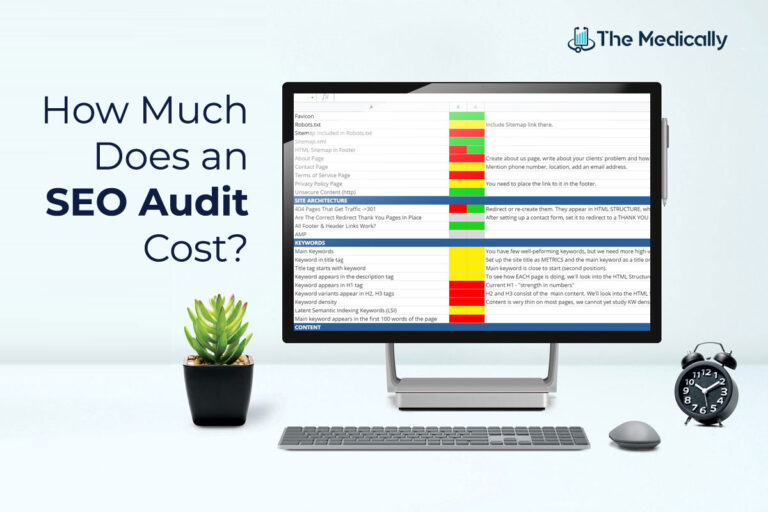
Every site we build is on WordPress, so you own it, with no proprietary platform lock-in. Every SEO engagement starts with a deep SEO audit of your current position, your local competition, and the specific content gaps keeping you from ranking where you should.
And every piece of content we produce is written by humans, reviewed for clinical accuracy, and structured for both Google and the AI systems that are reshaping how patients find care.
If your practice is not showing up where patients are searching, that is not a permanent condition. It is a problem we know how to solve. Get in touch with The Medically today.