

If your medical website is not showing up on Google, there is a reason, probably several. An SEO audit is how you find them.
But before you order one, you need to understand what you are actually paying for, what “free” audits are really worth, and why the price range in this industry is wide enough to drive a hospital system through.
The short version: a professional medical SEO audit costs anywhere from a few hundred dollars to well over $10,000 depending on who does it and what they actually cover.
At The Medically, our SEO audit is $950 and by the time you finish reading this, you will understand exactly why that price point makes sense for a medical practice, and what you should walk away from.
Table of Contents
What exactly is an SEO audit
An SEO audit is a comprehensive analysis of your website that identifies what’s preventing it from ranking on Google and LLMs, covering technical issues, content quality, keyword strategy, backlinks, and competitor gaps, so you know exactly what to fix and in what order.
Why you need an SEO audit before you do anything else
Most practices that come to us have already spent money on their website. A new design, some blog posts, maybe a Google Ads campaign. And they still cannot figure out why they are invisible in search.
The answer is almost never one thing.
It is usually a combination of technical issues Google cannot work around, content that does not match what patients are actually searching for, missing or broken signals that should be establishing your authority, and a competitive landscape that nobody has mapped out.
Sometimes even blatant technical issues, like an injury doctor in NYC, who paid 30K for a fancy website, only to find out after 3 years that the web designers (who had 0 SEO knowledge) blocked the website from the search engines. 3 years!
An SEO audit provides a comprehensive analysis of each aspect of your website, listing down all vital technical and fundamental SEO issues, including content optimization, technical issues, overall performance, and competitive analysis.
Think of it the way you would think about any diagnostic process in medicine.
You would not prescribe a treatment protocol before you knew what was wrong. An SEO audit is the diagnostic workup. Everything that comes after, content strategy, technical fixes, link building, schema implementation, should flow from what the audit reveals.
What SEO audits actually cost
Most US companies pay between $500 and $15,000 for a one-time SEO audit, depending on website size, depth of analysis, and the provider they hire.
A solid standard audit for a 200-page site typically falls in the $2,000 to $6,000 range. Anything under $500 is typically automated, and anything over $10,000 should be enterprise-level and come with a battle plan, not just a spreadsheet.
From low-cost audits available on freelancer platforms for under $100 to full-scale enterprise-level technical and content audits priced above $25,000 — the range is vast and depends on many factors.
Here is a practical breakdown of what those tiers actually mean:
- Under $500: Almost certainly automated or semi-automated. A tool runs your URL through a crawler, spits out a color-coded report, and emails it to you. You get a list of technical errors with no context, no prioritization, and no understanding of your specialty, your patients, or your competitive market.
- $500–$2,000: A step up: typically a freelancer or small agency (usually abroad) doing a manual review of core technical issues and basic on-page SEO. Better than a tool report, but usually light on content strategy, competitor analysis, and the healthcare-specific factors that actually determine whether a medical website ranks.
- $2,000–$15,000: The range where professional, comprehensive audits live. A senior SEO specialist spending meaningful time with your site, your analytics, your competitors, and your content. Actionable prioritized recommendations, not just a list of problems.
Our audit at The Medically is $950.
You get a high-level detailed audit, with a topical map, with access to our tools plus the battle plan for the next months. What others charge up to $15,000, we charge only $950.
It doesn’t mean we do a crap job, it means we keep our overhead to a minimum and you don’t pay for my fancy cars (I drive a 2011 Subaru Outback :)).
Free SEO audits: what they are actually worth
You have probably seen them. “Get your free SEO audit in 60 seconds.”
A form on an agency website, a Chrome extension, a Semrush or Moz widget. You enter your URL and get back a report with a score, some red and orange flags, and a list of things to fix.
These tools are not useless for what they are: a quick surface-level pulse check. But calling the output a professional SEO audit is like calling a blood pressure cuff reading a full physical.
Automatically generated free SEO audits have very limited value. These tools only provide raw data without strategic analysis. A real SEO audit requires a human expert to interpret the results: personalized recommendations make all the difference for your rankings.
A report generated by automated tools lacks orientation to the business goals of a given site, contains a list of fixes that is heavily generic, and lacks prioritization, so you end up spending time, money, and other resources improving things that will in no way recoup the expense.
It also lacks any analysis for AI-readiness: it cannot assess your content’s suitability for AI-powered search results like Google’s AI Overviews, which require deep contextual understanding and verifiable facts.
There is a specific dynamic in free audits that medical practices should be especially wary of.
An automated tool might flag that you have a missing meta description on a page. That is a real problem. But it has no idea whether that page is your most important service page or a staff bio from 2019 that should be deleted anyway.
It cannot tell you that your primary competitor is outranking you because they have 40 pages of topical content and you have three. It cannot evaluate whether your author bios meet Google’s E-E-A-T standards for a YMYL health website. It cannot assess whether your contact forms are HIPAA-compliant.
A human auditor who specializes in medical SEO can do all of those things. The free tool cannot.
What a proper Medical SEO audit actually covers
This is what separates a real audit from a tool-generated report: depth, context, and healthcare-specific expertise.
Here is what our $950 audit at The Medically covers:
- Domain history and authority. Before anything else, we check whether your domain has a clean history. Domains get bought, expire, get re-registered — and if your current site is sitting on a domain that was previously used for spam or black-hat SEO, you may be carrying a penalty you do not even know about. We run a full check on domain authority, trust rank, and archive history.
- Keyword research and site structure. We map out the keywords your potential patients are actually using, identify which pages should be targeting which queries, and flag anywhere your site is creating internal competition (keyword cannibalization) by having multiple pages that chase the same term.
- Meta tags and on-page signals. Title tags, meta descriptions, H1/H2/H3 structure, keyword placement and density, LSI keyword usage, duplicate meta tags — all of it. These are the foundational signals Google reads to understand what every page on your site is about.
- Technical SEO. Page speed and Core Web Vitals. Mobile-friendliness. HTML errors. Robots.txt and XML sitemap configuration. SSL certificates. Schema markup implementation. Crawlability. We look at your analytics data to examine bounce rate, traffic sources, time on page, and goal completions — not just the technical scaffolding but how real patients are actually behaving on your site.
- Backlink profile. Links from other websites to yours are one of the most significant ranking factors in Google’s algorithm. We audit the quality and quantity of your inbound links, the ratio of follow to no-follow links, your outbound link quality, your internal linking architecture, and broken links anywhere on the site. For medical practices, the authority of sites linking to you matters enormously — a link from a hospital system or a medical journal is worth far more than a link from a generic directory.
- Images and media. File sizes, file names, alt tags, captions, and whether you are using other media formats — video, podcasts — in ways that support your SEO.
- Reputation and local signals. Google Business Profile completeness and optimization, presence and quality of listings across healthcare directories, patient reviews, social media signals, and LinkedIn presence. For medical practices, reputation signals feed directly into both local ranking and E-E-A-T evaluation.
- Content audit. Length, quality, originality, formatting, grammar, and — critically for medical sites — clinical accuracy, authorship, and whether the content meets the YMYL standards Google applies to health information.
- Competitor analysis. We look at who is outranking you, why, and what the gap looks like. This is not just keyword gap analysis — it is understanding the full competitive landscape for your specialty in your geographic market.
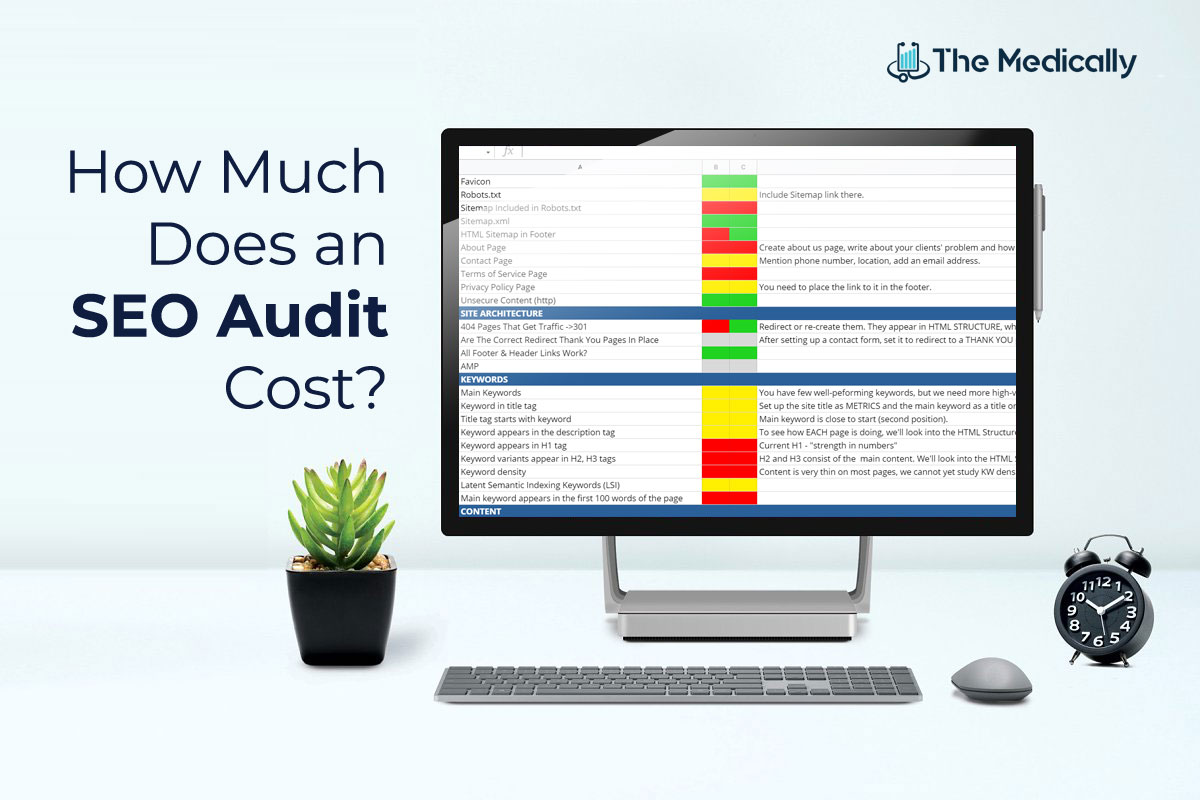
You receive all of this in a comprehensive spreadsheet with our full SEO audit checklist, proposed keywords, site structure with all pain points flagged with supporting data, and extensive recommendations.
And then — our clients’ favorite part — a dedicated video call where we walk through the entire audit together, show you the findings, and answer as many questions as you need to ask.
That last piece matters more than it might seem. A spreadsheet of SEO problems without interpretation is not much more useful than a tool report. The conversation is where the audit becomes a roadmap.
Why our competitors charge so much more
A medical SEO audit from an established healthcare marketing agency typically runs $2,500 to $15,000 or more.
It’s not better, they have a bigger overhead and some are just pricing up. A small agency like ours has a smaller overhead than an SEO agency with 400 people who are on the payroll.
What you get with us: I personally do all the SEO work and oversee client accounts, we don’t have juniors who learn on your website and mess up your rankings, because they have no idea what they do.
I run an “anti-agency” model and it has worked great for both myself and The Medically’s clients.
When should you get a Medical SEO audit?
There is no single right moment — there are several situations where an audit is exactly the right next step:
- Before your site launches. Instead of spending months discovering that your new website was built with SEO problems baked in, get an audit first. We will identify the right domain, recommend hosting and platforms, map out your initial content plan, and set up your keyword strategy before a single page goes live.
- After a traffic drop. If your rankings or organic traffic have fallen and you cannot explain why — a Google core update, a technical issue, a penalty, a shift in how your competitors are positioned — an audit gives you a diagnosis and a clear plan to recover.
- When your site never took off. Many practices invest in a website, wait six to twelve months, and get nothing. Before pouring more money into content or advertising, understand why the foundation is not working.
- Annually, as a maintenance check. Google’s algorithm changes constantly. Your competitors are not standing still. A yearly audit is the equivalent of a wellness visit for your online presence — a regular check to confirm your strategy is working and to identify what needs to evolve.
We’ve also had many clients who were in the process of redirecting websites from one domain to another and let’s say in some cases it turned out ugly, losing 15K product pages in one night, just because the “developer” didn’t know how to use .htaccess for a simple redirect.
It took us 6 months to get them back on track, but we did.
Now think that a $950 SEO audit would prevent such disasters from happening and you’d save 6 months of no indexation and NO SALES.
The $950 question
If your medical website is not performing the way it should, the worst thing you can do is keep making changes without understanding what is actually wrong.
More content will not help if your technical foundation is broken. I had a client who spent $50/article in the past years (800 articles in all). Junk content which not only never ranked, but it tanked their quality rating. Imagine the pleasure, when they were told they either re-write the content or just delete it. $40,000 in crap content that had to be either repurposed or just nuked.
Before you blindly spend money on content or, worse, post AI slop on your pages, let’s fix your technicals and create a proper topical map, then show you exactly how content needs to look like.
A site redesign will not help if you are targeting the wrong keywords. A new Google Business Profile will not help if your backlink profile is holding you down.
An SEO audit from The Medically gives you the full picture: every technical issue, every content gap, every competitive disadvantage, in a format you can understand, with a team that will walk you through it and answer your questions.
At $950, it is the most useful $950 most medical practices have ever spent on marketing.